
Lee Projected Versus Actual Release
Mississippi Department of Corrections uses the exact public label Tentative Release Date. The word “tentative” matters. MDOC computes parole, Earned Release Supervision, tentative release or discharge, and maximum release dates as distinct milestones. A public future date is not a discharge certificate and does not prove the person left an institution. Location and Unit may show a community ERS placement even while inmate status continues under MDOC jurisdiction.
A Lee County pretrial detainee has no sentence-based release date to calculate. Bond may be posted, a judge may issue an order, or another charge or detainer may prevent departure. Even a sentenced county inmate is not automatically governed by MDOC’s state-prison formula. The sentencing order, cause number, county jail credit, and sheriff’s policy for that sentence must be reconciled. No authoritative Lee County jail good-time or weekend-release policy was found.
Find Lee County Projected Release Dates
Begin with the custody system. The MDOC inmate search covers people in the state correctional system, not every person booked into Lee County jail. Search by first name, last name, or MDOC ID. The ID is the best discriminator. Open the detail and read Location, Unit, Location Change Date, sentences, and Tentative Release Date together. A short Lee County booking that ends by bond or dismissal may never appear there.
For a sentence served only in Lee County, obtain the filed sentencing order and ask Adult Jail/Corrections which credits apply. A court order establishes legal authority. The sheriff records the actual custody event. For state time, MDOC Records owns the calculation. These offices answer different parts of the same question.
- Identify whether Lee County, MDOC, USMS, BOP, or ICE currently controls the custody record.
- For an MDOC person, search by MDOC ID when possible and compare full identity and sentence details.
- Record the exact “Tentative Release Date” label, plus Location and Unit. Do not drop the qualifier.
- For a Lee County sentence, obtain the sentencing order and ask the sheriff about verified jail credit and release processing.
- Check parole, ERS, court, and detainer records for events that may change the date or destination.
- Confirm physical departure with the releasing agency and request a discharge or release record when durable proof is needed.
The Lee County released-inmate search path separates the county, state, VINE, court, and federal branches when the last custodian is uncertain.
Lee MDOC Release-Date Fields
The public MDOC detail includes far more than a date. It may display a corrections photograph, full name, MDOC number, physical descriptors, Entry Date, Location, Unit, Location Change Date, total sentence data, conviction county, and sentence date. That context is essential. Two people can share a name, and a location change may show that the person left a prison building for ERS without reaching full discharge.
| Field | What it helps establish |
|---|---|
| MDOC number | Matches the correct state correctional identity |
| Location and Unit | Shows an institution or a named community ERS placement |
| Location Change Date | Marks when the displayed assignment changed |
| Sentence details | Connects the date to conviction county and sentence structure |
| Tentative Release Date | Shows MDOC’s prospective public date, not actual discharge |
The official MDOC example detail illustrates the field layout and exact label.
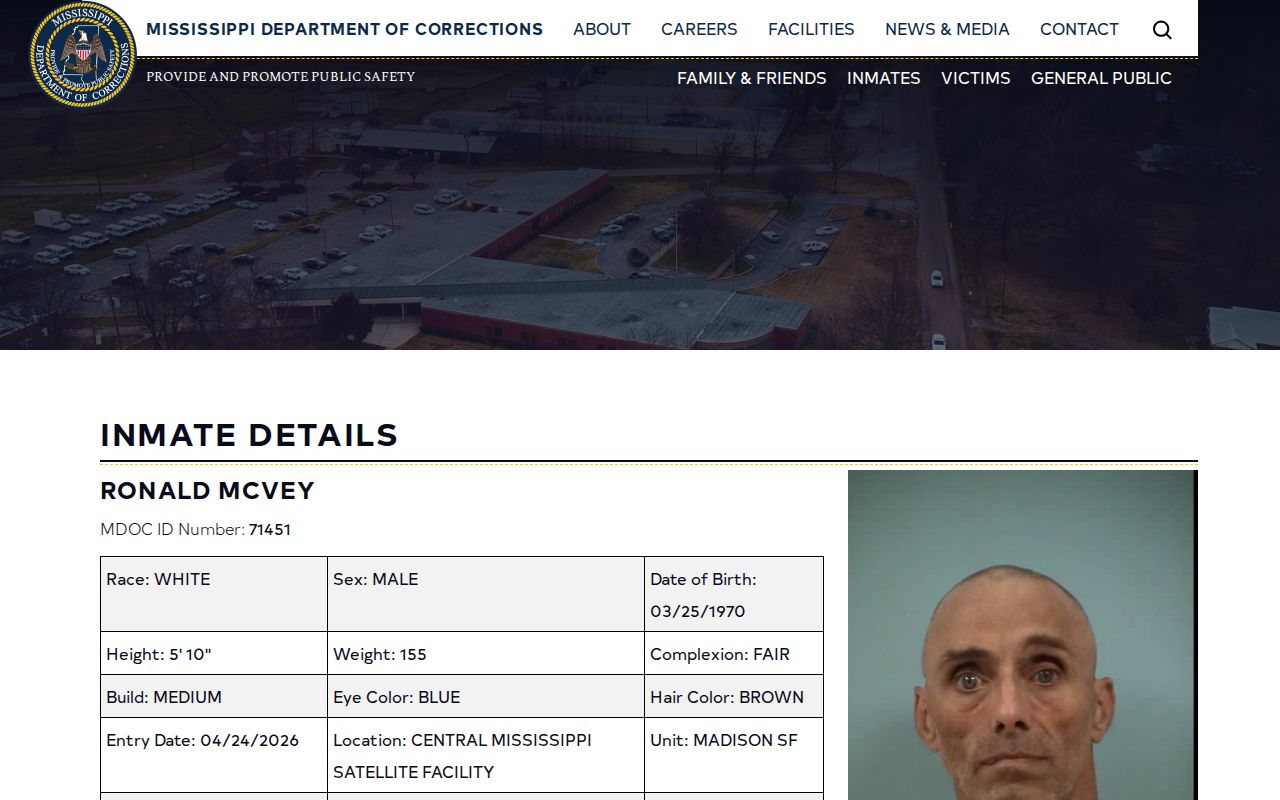
The image is a layout example, not evidence about a Lee County jail release or the editorial subject of a search.
Lee Release Dates and Earned Time
For sentences imposed after June 30, 1995, Miss. Code § 47-5-138(5) permits eligible inmates to receive 4.5 days of earned time for each 30 days served. The credit depends on conduct and performance and is capped at 15 percent of the sentence. That supports the shorthand “up to 15 percent credit” or “roughly 85 percent served.” It does not promise release at 85 percent.
Statutory exclusions and forfeiture can change the credit. Offense rules, sentence dates, consecutive or concurrent terms, parole, ERS, detainers, county jail credit, and later court action also affect the computation. The older 50-percent language in subsection (1) expressly does not apply to post-June 30, 1995 sentences. Pulling that figure out of context would produce a false estimate.
Subsection (6) places a qualifying early release into ERS until sentence expiration. The person retains inmate status under MDOC jurisdiction. Subsection (7) addresses revocation. ERS is therefore a form of community placement, not the same as full discharge. An MDOC location can look local while the sentence still runs.
Parole follows a different statute and a Board decision. A parole eligibility date is not the tentative release date, and eligibility never guarantees a grant. MDOC can also hold a person while release plans or another agency’s detainer is resolved. Several dates may all be valid for different purposes. Ask which milestone a date names before comparing it with a court order or a family report.
Lee Jail Credit Changes Release Dates
Presentence time in Lee County may be an input to MDOC’s calculation when it is eligible and tied to the correct cause number. The MDOC handbook says the agency seeks verification from the county of conviction. That is why simply adding the sentence length to the sentence date is unreliable. Court commitment papers, the sheriff’s jail-credit verification, and MDOC’s time sheet must refer to the same case.
MDOC also computes multiple milestones, not one universal date. Parole eligibility comes from a separate statute and Board process. ERS has its own rules. A maximum date may differ from the tentative date. Detainers and sentence structure can prevent the expected community departure. For person-specific accuracy, request the nonexempt time sheet and status history rather than building a homemade calculator.
Note: County jail time does not reduce a state sentence unless MDOC can verify eligible credit for the matching cause.
Lee County Sentence Record Sources
Legal authority and physical custody come from different records. A filed sentencing order states the term and structure imposed by the court. Later amended judgments, revocation orders, bond or release orders, and satisfaction entries can change the legal picture. The Lee Circuit Clerk is the route for felony Circuit Court files. Justice, County, and municipal courts may hold other Lee cases even though the same adult jail housed the person.
Ask the clerk for documents, not a release-date calculation. A focused request identifies the case number and seeks the final disposition, sentence, later amendment, release or bond order, revocation, or discharge entry. Then give MDOC the matching cause number when state time is involved. The sheriff confirms county jail credit and the county departure. MDOC applies verified credit and state rules to its time computation. This division keeps a court’s legal date from being mistaken for the day custody staff completed release processing.
When the offense began in a municipal or Justice Court but later moved to Circuit Court, search each relevant docket rather than assuming one county booking points to one clerk. The adult facility centralizes custody for Tupelo and other Lee municipalities, but it does not centralize every legal file. The originating charge and filed orders identify the right record trail.
Why Lee Release Dates Change
A projected date can move for lawful and administrative reasons. The change does not by itself show an error. It may reflect new verified credit, loss of earned time, a revised order, a hold from another agency, or a status path such as parole or ERS. Read each source within its own scope.
| Factor | Possible effect | Record owner |
|---|---|---|
| Verified Lee jail credit | Changes time credited to the cause | Sheriff, court, and MDOC |
| Earned-time award or loss | Moves the tentative milestone within statutory limits | MDOC |
| Concurrent or consecutive terms | Changes how sentences overlap or follow each other | Court and MDOC |
| Detainer or hold | Can block community departure or cause transfer | Holding and receiving agencies |
| Parole or ERS | Creates a community-supervision milestone, not full discharge | Parole Board or MDOC |
| Later court order | Can amend the sentence or release authority | Sentencing court |
MDOC advises that eligibility dates do not guarantee release. The agency communicates the actual date after verification, and processing may take 30 to 45 days. A discharge certificate is required before release. Those steps explain why a date can arrive while release processing or another hold still remains.
A court amendment can change the sentence MDOC applies, but the docket does not prove when prison staff completed departure processing. A public location change can show a custodial move without explaining its legal basis. Pair the filed order with the agency’s status-change record, then compare the cause number, MDOC number, and effective dates.
Confirm Lee County Actual Release
Use a future date to plan a verification step, not to declare that the person is out. A matched VINE registration may provide a custody-change alert, but the reporting agency confirms what that event means. The Lee County VINELink inmate search explains the reporting-agency check and registration path. For MDOC, ask Records whether the person is institutionally confined, on ERS, paroled, transferred, or discharged.
If the person came from Lee County jail, obtain the sheriff’s release or transfer record as well. A county departure to MDOC, USMS, ICE, or another county is not unrestricted community release. For a federal sentenced person, BOP’s “Released” means no longer in BOP custody and may coexist with supervision or another agency’s custody. A pretrial USMS person may never appear as a sentenced BOP inmate.
The strongest final statement uses the exact agency label and date: tentative, eligible, ERS, paroled, released from a named custodian, transferred, or fully discharged. These terms are not interchangeable. When sources conflict, preserve both records and ask their owners to resolve the difference.
For a focused MDOC request, provide the name and MDOC ID and ask for the actual release or discharge date and mechanism, nonexempt time sheet, discharge certificate, and enough location history to separate institutional custody from ERS, parole, transfer, or discharge. For Lee County, provide booking and cause numbers when known and ask the sheriff for the actual departure date, release disposition, or transfer destination.