
Lee County Parole or Probation
Parole and probation can both require a person to report in the community, but they do not prove the same custody history. Mississippi parole follows an MDOC prison sentence and a grant by the Mississippi State Parole Board. Probation is a court-ordered community sentence. Someone on probation may never have entered a state prison. Earned Release Supervision, often shown as ERS, is different again. A person on ERS may have left a prison institution while retaining inmate status under MDOC jurisdiction through sentence expiration.
The source must fit the question. The state parolee database is the strongest public route for active parole. A filed Lee County court order explains probation. An MDOC inmate detail can show a community ERS location, but its “Tentative Release Date” is not a parole record or a discharge certificate. The Lee jail roster answers present county custody only. It does not show the full set of people reporting to community corrections.
| Status | How it begins | Best verification route |
|---|---|---|
| Parole | Board-approved release after an MDOC prison sentence | Mississippi parolee search, then the Lee office |
| Probation | Court-ordered community sentence | Filed sentencing or probation order and court clerk |
| ERS | Conditional early release under MDOC rules | MDOC Location and Unit, then MDOC Records |
| Discharge | Sentence or supervision ends | Discharge or status-change record from the responsible agency |
- Parole
- Conditional community release after a state prison term.
- Probation
- A community sentence imposed and controlled by a court.
- ERS
- Earned Release Supervision, with inmate status continuing under MDOC jurisdiction.
- Discharge
- The documented end of the sentence or supervision term at issue.
Verify Lee County Post-Release Supervision
Start with the Mississippi parolee search. It accepts Last Name, First Name, MDOC ID Number, City, and County. An MDOC ID is the best match key. Search by name or ID before narrowing to Tupelo or Lee County, since a county filter can hide a record tied to a different reporting location. A match verifies that Mississippi identifies the person under parole supervision. It does not establish the date that Lee County jail released the person.
If parole does not fit, find the filed court record. Probation comes from the sentencing court, so a docket entry or order is more useful than the parolee tool. For possible ERS, search the MDOC inmate database and read Location, Unit, and Location Change Date together. A community-named ERS location can mean release from a prison building while MDOC still treats the person as an inmate.
- Match the full name and MDOC number in the statewide parolee search. Use City or County only as a later filter.
- Read the status as active supervision, not as proof of the original Lee County jail departure.
- Check MDOC Location and Unit when ERS or a state transfer may explain the record.
- Use the filed sentencing order when the supervision is probation rather than parole.
- Ask the Lee office or MDOC Records for only the public confirmation needed when the searches do not resolve the status.
Note: A fully discharged historical record may require a narrow written request because public search retention is not guaranteed.
Lee County Supervision Office Details
The Lee Probation & Parole Office is MDOC’s local community corrections point. It is not a jail and has no current-custody roster. A supervised person can contact it to clarify an assigned agent or reporting duty. Another caller should request only information that the office may lawfully disclose. Private conditions, schedules, and case notes may not be available.
Lee Probation & Parole Office
161 Clark Street, Suites 1 and 2
Tupelo, MS 38802
Mail: P.O. Box 1501, Tupelo, MS 38802
Phone: 662-841-1884
Fax: 662-840-4028
The official page names Tony P. Harris as Community Corrections Director. No office hours are published in the research, so call before a visit. For a state record, MDOC Records can be reached at P.O. Box 24388, Jackson, MS 39225, 601-933-2889, or MDOCRecordsDepartment@mdoc.state.ms.us. Those channels serve different jobs: the Tupelo office handles local supervision, while the Records Department can answer a focused request for status history or discharge documentation.
The state parolee-search screen shows the name, ID, city, and county fields used in the public lookup.
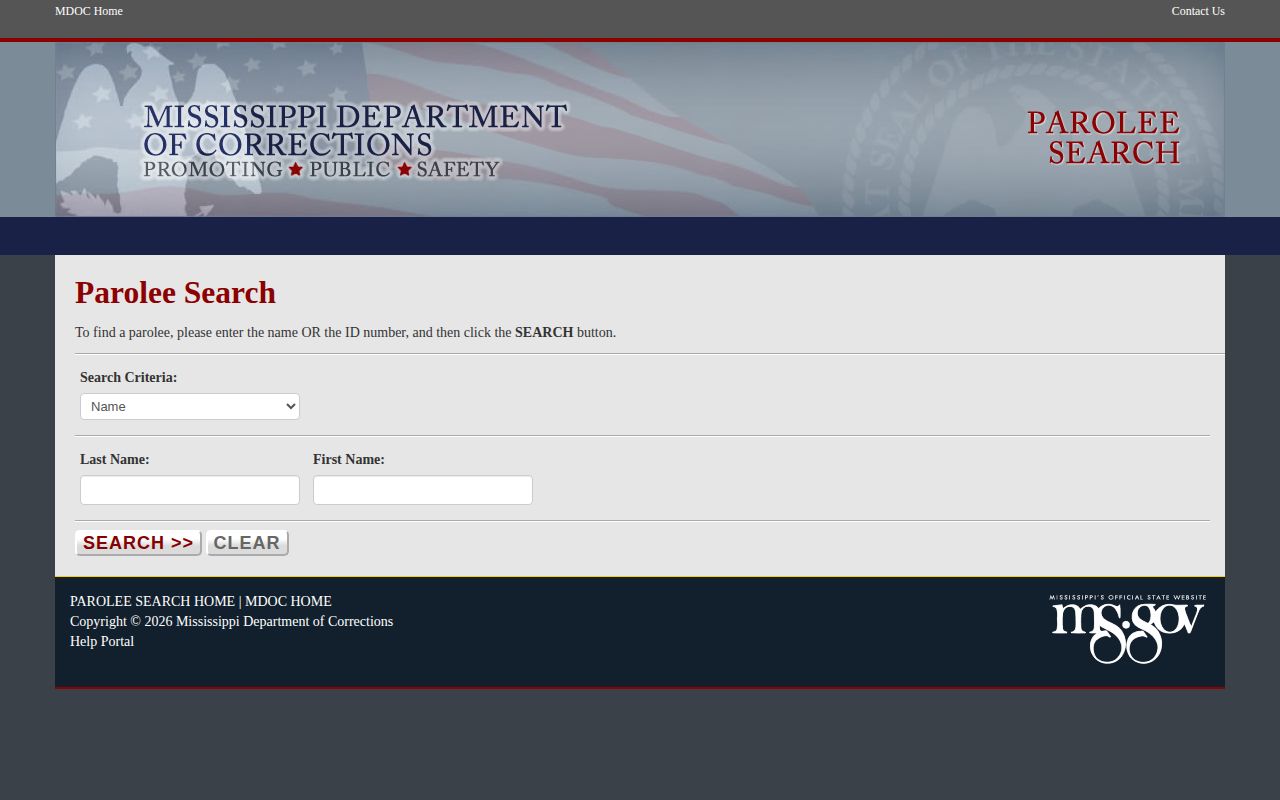
The screen confirms why a broad name or MDOC-number search should come before a Lee County filter.
Lee Work Center Is Custody
The Lee County Inmate Work Center occupies the old county-jail setting and serves selected sentenced, nonviolent inmates. That can sound like community reentry. It is not. An assignment there remains county confinement, uses jail services, and is separate from probation, parole, or ERS. Moving from the Adult Detention Facility to the Work Center should never be labeled a release.
Confirm the final county departure through the sheriff’s release channels. If a state sentence follows, MDOC records may then show a prison location or a later community supervision status. The Clark Street office is the local post-release supervision contact. The Work Center is a custodial program. Keeping those institutions separate prevents a location change from being mistaken for the end of custody.
Lee County Violations and Absconders
Supervision conditions are the rules attached to parole, probation, or ERS. A violation allegation may lead to a warrant, revocation process, return to custody, or another agency event, depending on the order and status. An absconder is a supervised person alleged to have stopped reporting or remained unavailable. That label is not a new conviction, and it does not prove present custody in the Lee County jail.
No authoritative public Lee County absconder list was found. Do not infer one from a missing parolee result or a jail roster. Check the public state searches and contact the supervising office. Mississippi SAVIN/VINE can issue notices for supervision absconding, return to custody, release, and transfer when its contributing agency reports an event. The reporting agency still owns the underlying record and should confirm what occurred.
A warrant also does not establish physical arrest. When a court order, MDOC status, and VINE notice appear to conflict, record each source’s exact label and access date. Ask the agency that supplied the event to explain its own record. One system’s silence cannot be converted into a broader conclusion.
Mississippi’s notification system can produce more than one alert as custody and supervision change. A transfer, return to custody, release, or supervision absconding notice may arrive close to another event. Read the full sequence. The Registration Link can carry a registration from a participating county record into MDOC after a felony transfer. That continuity helps, but it also shows why a Lee roster departure should not be called community release until the destination is known.
Lee County Parole Hearing Records
Mississippi parole consideration is scheduled monthly, but no public individual calendar or searchable decisions database was found. State administrative rules say hearings are closed. Staff set appointments, and specified parties receive notice. Decisions may grant, deny, or revoke parole, while broader disclosure is handled case by case under safety and confidentiality rules.
The Mississippi State Parole Board is at 239 N. Lamar Street, Suite 501, Jackson, MS 39202. Its phone is 601-576-3520 and email is MSStateParoleBoard@mdoc.state.ms.us. Eligibility under Miss. Code § 47-7-3 depends on the offense, sentence dates, classifications, exclusions, and other case facts. Eligibility does not mean parole was granted. A grant may also precede physical departure while housing plans or holds are resolved.
State rules say the offender and specified parties receive decision notice. Other disclosure is handled case by case under safety and confidentiality limits. Official actions and reasons remain in Board minutes. The parolee search should therefore be used for its actual role: confirming active parole after the status reaches that database. It cannot supply a missing public hearing calendar, recreate the Board’s deliberation, or prove the time of physical departure.
Lee County Supervision Discharge
Supervision ends through the legal process tied to the status. Probation ends under the court’s order. Parole ends under the state sentence and Board framework. ERS continues under MDOC jurisdiction until the applicable sentence expiration unless revoked or otherwise changed. A discharge record is stronger than a missing public-search result because neither state tool promises that fully completed historical records remain online indefinitely.
For a durable state history, request the actual status-change or discharge record, location history, and the nonexempt material needed to distinguish parole, ERS, transfer, and full discharge. For a prior Lee jail booking, the sheriff’s Arrest/Release Form answers the county departure, not the later end of state supervision. The Lee County released-inmate search and records path explains how to reconcile the county, MDOC, VINE, and court sources.