
Lee County Three-Day Release Feed
Lee County has a genuine public Released Last 72hrs endpoint supplied through Tiger Correctional Services. The sheriff's wrapper labels the route Recently Released. The rolling window offers more time to catch a Friday, weekend, or multi-day release than a same-day check. It is not an archive. Once an entry ages beyond the stated period, its disappearance is expected.
List membership is the online release signal. It means Tiger placed that booking in its released category during the window. It does not reveal the final destination by itself. The person may have returned to the community, gone to MDOC, moved to another county, or entered federal or immigration custody. A release from Lee County is not always the end of custody.
Check Lee County 72-Hour Releases
Start with the released view, not the active roster or the Booked Last 72hrs page. Those three screens answer different questions. The booked query uses first72; the released query uses last72. The similarity of the labels makes this distinction important.
- Open the Lee County Sheriff inmate search and select Recently Released.
- Search the released list by last name. Note the access date and displayed result count because both can change.
- Compare name, age, gender, photo, booking number, booking time, arresting agency, and charges. Do not match by a common name or image alone.
- Open the detail and record exactly what the Release Date field says. Do not replace
N/Awith an estimate. - Check the active roster when custody is still in doubt. A current active entry is the stronger Lee County custody signal.
- Call 662-432-2632 or request the Arrest/Release Form when the date, mechanism, or destination is unclear.
The Lee County same-day release route explains why only a detail with an actual recent timestamp supports a narrower 24-hour claim. The county publishes no separate 24-hour feed.
The official 72-hour source is pictured below. The live county release feed should be checked directly for current data.
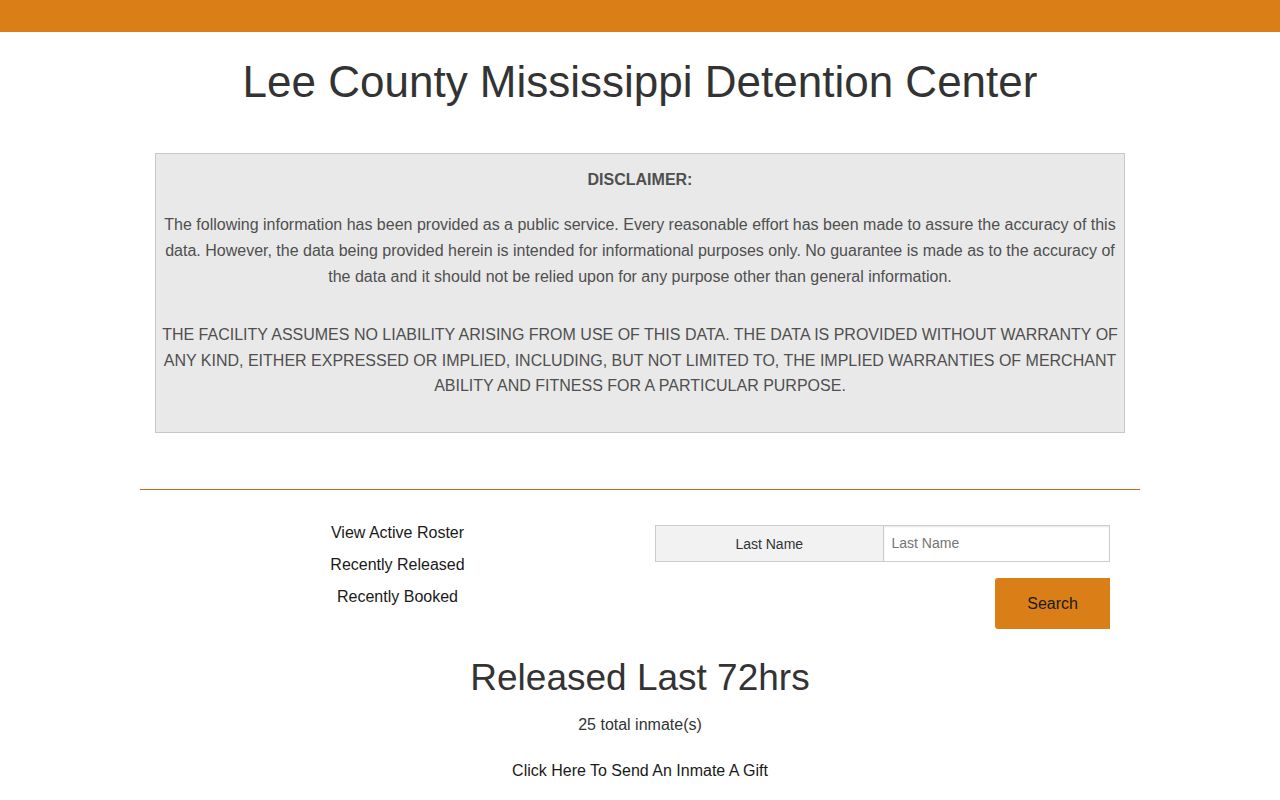
The capture shows the verified window and helps separate it from the active and recently booked screens.
Lee County Release List Fields
The list itself shows a count, name, gender, age, and a detail link, plus last-name search. The detail expands the booking record. No public release-reason field was established, and the Release Date field can be blank even when the person appears in the released category.
| Field | How to read it |
|---|---|
| Name, gender, age | Initial match clues, not sole proof of identity. |
| Booking number and time | Identifies the booking cycle and supports a focused record request. |
| Arresting agency | Points toward the agency and court tied to the case. |
| Release Date | May show a date or N/A; list status does not fill the blank. |
| Charges | Allegations associated with the booking, not final court disposition. |
| Bond and fine amounts | Displayed financial data, not proof of payment or release. |
| Photo and descriptors | Supporting identity data that can be missing or outdated. |
A Lee County release record should be tied to the booking event. The sheriff form is the better source for actual date, time, and the recorded release disposition or transfer destination. The court file explains legal authority. Neither a bond amount nor a scheduled date proves physical departure.
Lee County Weekend Release Checks
The three-day span is well suited to a Monday check after a weekend. It captures more elapsed time than a single calendar-day view and avoids assuming that a departure must appear under the day someone expected it. Lee County does not publish a special holiday schedule or a fixed feed update cadence, so no hour-by-hour promise should be made.
A filed court order can authorize release, yet jail staff still must receive and process it and resolve other charges, warrants, sentences, or detainers. If the active roster still lists the person, call the jail rather than asking someone to travel there. If the person later enters last72, the county booking was then categorized as released. The form is still needed when exact timing matters.
Note: The 72-hour view reduces missed weekend entries, but it does not turn a court order or expected date into proof of departure.
Confirm Older Lee County Releases
After the 72-hour entry expires, request the sheriff's Arrest/Release Form. Lee County lists the first copy at $5 and each extra copy at $1, with money-order payment and no cash. Confirm the current submission method before paying. Supply the full name, booking number if known, and approximate date. Ask for the actual departure time and nonexempt disposition or transfer destination.
The county form and fee source is the durable county route. If the sheriff response shows transfer, follow the receiving system. Search MDOC by name or ID for state custody, read Location and Unit, and do not treat a Tentative Release Date as an actual discharge. Search the separate parolee system for active parole. VINE can report a custody event, but the reporting agency must confirm it.
For legal outcome, identify the correct Lee court from the arresting agency and charge. Circuit, Justice, County, and municipal records can remain separate even though adults from Tupelo and other Lee municipalities enter the same jail system. A filed disposition may outlast the web feed, though it may not show the exact physical departure time.
Lee County Release Date N/A
The distinctive Lee County data quirk is an entry that appears in Released Last 72hrs while its person detail says Release Date: N/A. The two signals must stay side by side. List placement establishes the vendor's release category at the time of access. The blank field means the public detail does not supply the date.
Possible display lag or field logic may be tempting explanations, but no source establishes the cause. Keep a dated note of the screen when there is a legitimate need, then ask the sheriff for the Arrest/Release Form. The request can name the mismatch and ask for actual departure date, time, and transfer or release disposition.
Trace Lee County Release Destinations
A recent release feed records departure from the county booking, not the whole custody chain. A new MDOC location can show state commitment. An ERS location can mean the person is in the community while still under MDOC inmate jurisdiction. A VINE alert may show release, transfer, or another event from its reporting agency. A federal pretrial person may be handled by the U.S. Marshals Service without becoming a sentenced BOP inmate.
| Question | Best next source |
|---|---|
| Exact county departure | Lee County Arrest/Release Form |
| State transfer or status | MDOC inmate search and records |
| Active parole | Mississippi parolee search |
| Legal reason for release | Filed order from the correct court |
| Federal or immigration move | USMS/court, BOP, or ICE as applicable |
For a named-person workflow spanning all of these branches, use the Lee County released inmate search. A missing public result is best reported as no record located in the tools checked on that date, not as proof the person was never booked or is free of custody.
Lee County's adult facility receives prisoners from Tupelo and other municipalities across the county. The shared Tiger roster does not mean every case is filed in the same court. The arresting agency and charge can point to Circuit, Justice, County, or a municipal court. Search the filed order in the correct venue and use the sheriff record to establish physical departure.
A person moved to the Lee County Inmate Work Center has not been released merely because the main-facility location changed. The Work Center holds selected nonviolent sentenced inmates and remains a county custodial setting. The eventual community departure should appear through the same sheriff release channels or be documented by the Arrest/Release Form.
Juvenile custody is separate and generally confidential. The adult Tiger feed should not be used to build a released-juvenile lookup or to reconstruct protected records. The same restraint applies to sealed and expunged material. A blank public result can reflect a lawful access limit rather than a data error.